Aral Sea & Moynaq Trip: What to Expect
The ship graveyard, the drive across the Ustyurt Plateau, and an honest look at what this trip actually involves — and whether it's worth it for you.
In this guide
What happened to the Aral Sea
The Aral Sea was once the fourth-largest lake in the world. Starting in the 1960s, Soviet irrigation projects diverted the two rivers that fed it — the Amu Darya and Syr Darya — to grow cotton across the desert. Over the following decades the sea shrank dramatically, splitting into separate remnants and leaving what is now widely regarded as one of the starkest human-caused environmental disasters on Earth. Former fishing towns that once sat on the coast, like Moynaq, are today separated from any water by well over 100 km of dried seabed, now a salt-crusted desert called the Aralkum.
Moynaq and the ship graveyard
Moynaq (also spelled Muynak) was once a thriving fishing port with a Soviet-era cannery. As the sea retreated, the town's fishing fleet was simply abandoned where it lay — and a cluster of rusting hulls, half-buried in sand, has sat on what used to be the harbor bed ever since. It's now the single most-photographed symbol of the Aral Sea disaster, and there's a small museum in town with photographs of Moynaq when it was still a working port, which helps make sense of what you're looking at.
The route: distances and how the trip is structured
Moynaq sits roughly 200 km north of Nukus, itself around 180 km from Khiva — so this isn't a day trip you bolt onto a Khiva itinerary casually. Most operators structure it as an overnight or multi-night expedition, often continuing past Moynaq and across the Ustyurt Plateau toward the receding shoreline itself, camping at a yurt camp along the way.
- 2 days / 1 night, departing Nukus — the shortest version, for travelers already in Karakalpakstan.
- 3 days / 2 nights, departing Khiva — the most common option for Khiva-based travelers, including the drive to and from Nukus.
- 3 days / 2 nights, departing Bukhara — for those routing the Aral Sea into a longer Silk Road loop.
Most itineraries also include a stop at the Mizdakhan necropolis near Nukus, an ancient and still-active burial site with structures dating back over a thousand years, and a night at a desert yurt camp on the Ustyurt Plateau.
Our Aral Sea Expedition covers this exact route by 4x4 — Moynaq's ship graveyard, the drive across the Ustyurt Plateau, a night at a desert yurt camp, and the Mizdakhan necropolis. From $450/person (2 days/1 night, Nukus departure) up to $650/person (3 days/2 nights, Bukhara departure); solo travelers add a supplement. Ask about the next departure →
What to actually expect on the ground
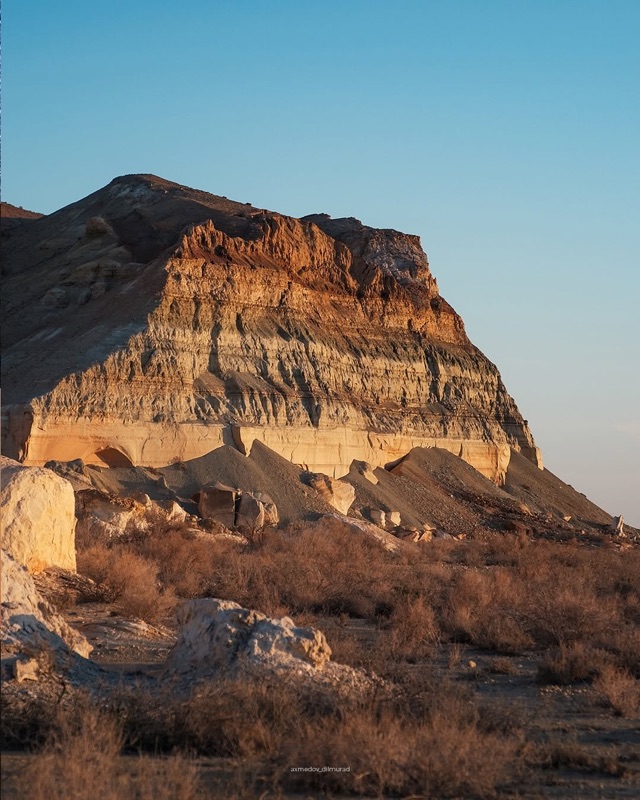
This is not a polished tourist attraction — there's no visitor center at the shoreline itself, and much of the drive is on rough 4x4 track across the Ustyurt Plateau, a genuinely remote, empty landscape. Expect long stretches of driving between highlights, basic yurt-camp accommodation (no hot showers, shared facilities), and a real sense of desolation at Moynaq itself that photographs don't fully convey. It's a trip for travelers who want to see the scale of the disaster firsthand, not a comfort-focused excursion.
Is it worth the trip?
If you care about the story — Soviet-era environmental policy, the human cost to the fishing communities that depended on the sea, or simply witnessing a landscape genuinely reshaped within living memory — yes, this is one of the most striking things you can see in Central Asia, precisely because so few travelers make the effort to reach it. If you're short on time or mainly interested in architecture and Silk Road history, your days are probably better spent between Khiva, Bukhara, and Samarkand instead.
How to prepare
- Pack for genuine desert conditions: layers for cold nights, sun protection for hot days, sturdy shoes.
- Bring more water and snacks than you think you need — services are sparse between towns.
- Yurt camp stays mean no reliable power or hot water; bring a power bank and don't expect a hot shower.
- Phone signal is unreliable to nonexistent across much of the Ustyurt Plateau.
- Book with an operator who runs a proper 4x4 and knows the route — this isn't terrain for a rental sedan.