Ayaz-Kala: History, How to Get There, Best Time
The story behind Khorezm's most striking desert fortress, how to reach it from Khiva, and why sunset is the moment to build your visit around.
In this guide
History: three fortresses, three eras
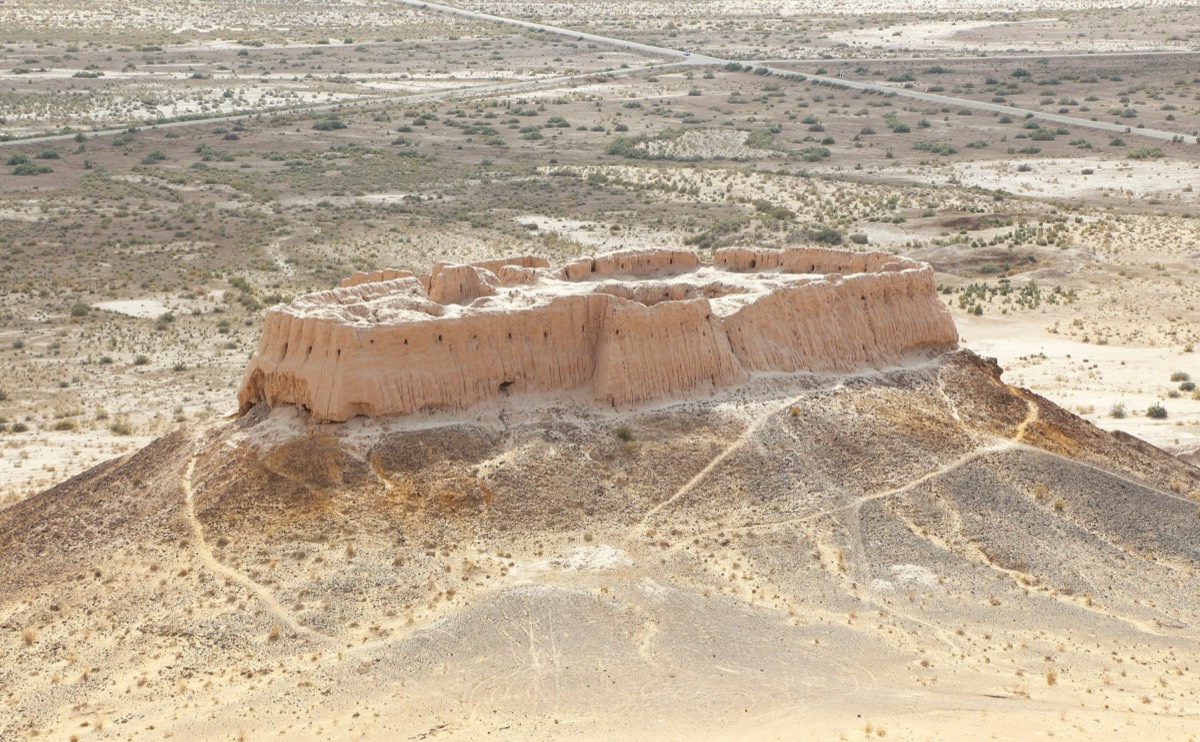
"Ayaz-Kala" isn't one fortress but three, built on and around the same ridge overlooking the desert at different points in Khorezm's history. Ayaz-Kala 1, the oldest and most visually striking, dates to roughly the 4th–2nd century BCE, with massive rammed-earth walls still standing over 10 meters high in places. Ayaz-Kala 2 sits on a lower hill nearby and was built later, likely in the early medieval period. Ayaz-Kala 3, a smaller fortified residence at the foot of the ridge, dates to around the 6th–8th century CE. Together they illustrate roughly a thousand years of continuous use of the same strategic high ground, guarding the northern approach to the irrigated Khorezm oasis.
The name itself is often translated as connected to a legendary figure, though like much of the oral history around these sites, the details are folklore layered onto genuine archaeology — the walls themselves are the reliable part of the story.
What you'll actually see on site
There's no visitor center, no signage, and no reconstruction — Ayaz-Kala is a real ruin, not a restored monument. What you'll find: the eroded but still-massive perimeter walls of Ayaz-Kala 1, climbable in places with care, giving a 360-degree view across the Kyzylkum desert; the lower, gentler slopes of Ayaz-Kala 2; and the compact walls of Ayaz-Kala 3 down near the yurt camp at the base of the ridge. Most visitors spend the bulk of their time at Ayaz-Kala 1 for the views and the walk along the walls.
How to get there from Khiva
Ayaz-Kala is roughly 2 to 2.5 hours' drive from Khiva, across the Amu Darya and into Karakalpakstan on a mix of paved highway and, for the final stretch, an unpaved desert track. There's no public transport option — you need a private vehicle, either self-arranged with a local driver or as part of a guided tour. It's usually visited alongside Toprak-Kala and Kyzyl-Kala, which sit roughly on the way, rather than as a standalone trip (see our full desert fortresses guide for how the sites connect).
Both our half-day and full-day fortress tours include Ayaz-Kala. The Ellik-Qala Expedition (full day, from $75/person) and the overnight Desert & Yurt Camp (from $150/person, timed for sunset at Ayaz-Kala) both build the route around it. Enquire about dates →
Best time to visit
Spring (April–May) and autumn (September–October) give the most comfortable temperatures for the climb up Ayaz-Kala 1's walls and the best light for photography. Summer visits are best done early morning or, ideally, timed for evening — midday sun on exposed desert walls is intense from June through August.
Why sunset is the moment to plan around
If you visit only one desert fortress at golden hour, make it Ayaz-Kala. The ridge faces open desert with nothing to block the horizon, and the rammed-earth walls turn a deep orange-red as the light drops — it's the single most photographed moment among all the Ellik-Qala sites. This is also why the overnight yurt camp route is popular: it lets you catch sunset at the fortress without needing to rush back to Khiva in the dark, then wake up for a quiet sunrise over the dunes before heading back.
Practical tips
- Entry fee is roughly $3–4 per person, paid in cash locally.
- Wear closed shoes with grip — the climb up the eroded walls is uneven, not a paved path.
- Bring more water than you think you need; there's no shop on site.
- If staying overnight at the yurt camp, pack a light layer for after dark — desert nights cool quickly even in summer.
- Phone signal is weak to nonexistent at the site — download offline maps in advance if self-driving.